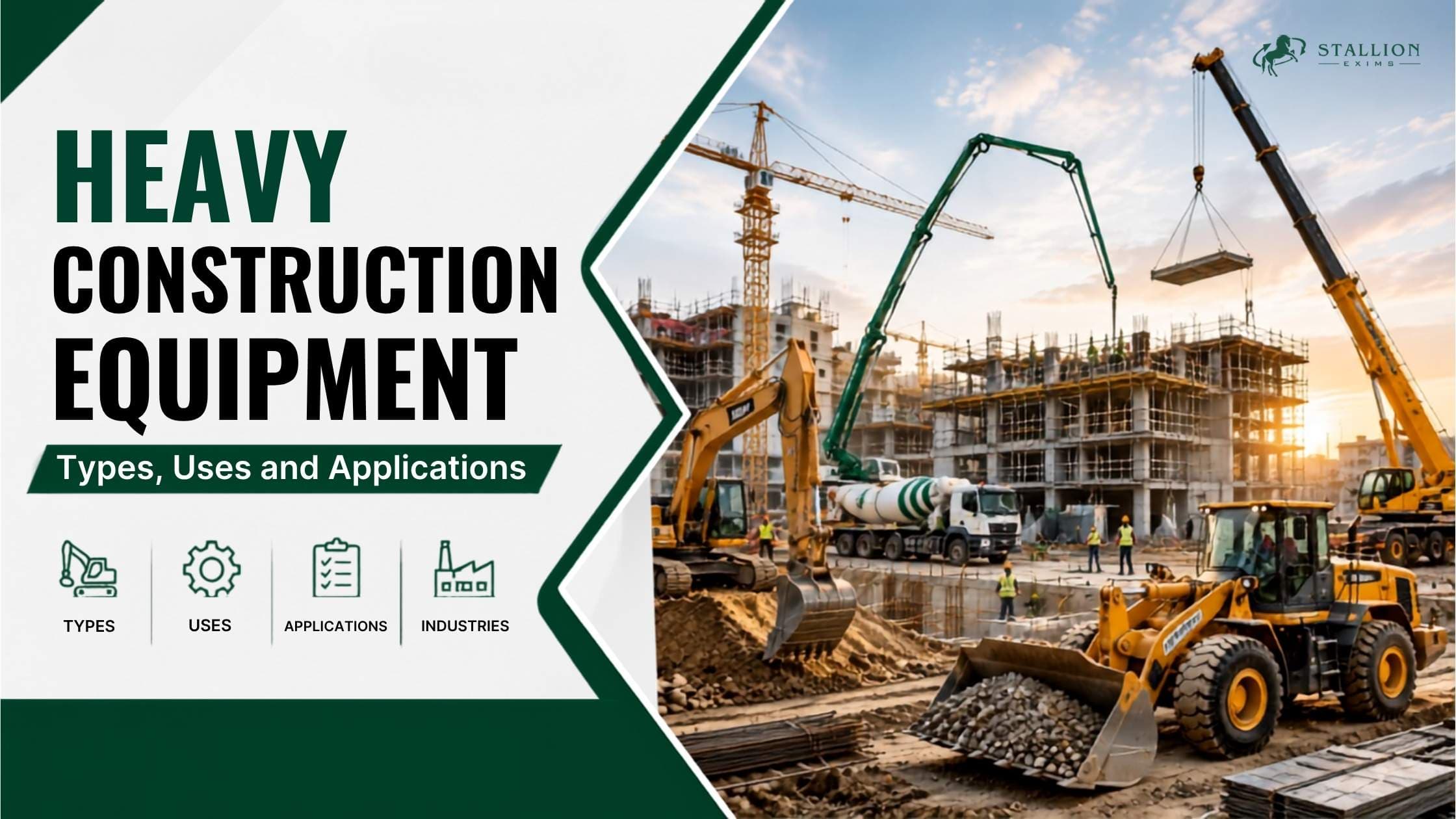
Heavy Construction Equipment: Types, Uses and Applications
Published on 21 July 2026•By Prateek Nahar
Modern building projects require speed, power and total safety. Manual work cannot handle massive loads or dig deep foundations fast enough for today's needs. This is exactly where heavy construction equipment becomes essential. These big machines help workers finish large scale tasks easily. From building skyscrapers to laying long roads, heavy equipment used in construction changes how we build. Whether you manage a small site or a huge mining project, choosing right machinery saves valuable time and money. Every successful contractor knows that good tools bring great results. In this guide, we will explore different types of heavy equipment, their main uses and how they make modern construction possible. We will also discuss how to maintain these machines and keep your site safe.
What is Heavy Construction Equipment?
Heavy construction equipment refers to heavy duty machines designed for massive building tasks. These powerful vehicles perform earthmoving, lifting, drilling and material handling. A typical heavy construction equipment list includes machines with strong metal tracks or large tires to move on rough ground. They feature advanced hydraulic systems that give them immense power to lift heavy weights or break hard rocks. You will find these types of heavy equipment machines on almost every building site. They act as main driving force behind rapid urban development. Without heavy machinery, modern cities and long highways would be impossible to build.
Why Heavy Construction Equipment is Important
Using heavy construction machines offers many great benefits for any building project. Manual labor takes a long time and comes with high safety risks. Heavy machinery solves these common problems quickly.
Faster project completion: Machines work quickly to save time and finish jobs on schedule.
Higher productivity: A single heavy machine can do work of fifty people in one hour.
Improved safety: Good equipment keeps manual workers away from dangerous lifting tasks.
Better accuracy: Modern technology helps operators dig and lift with perfect control.
Reduced labor: Projects need fewer manual workers when big machines do heavy lifting.
Cost efficiency: Faster work means you spend less money on daily wages and project delays.
Types of Heavy Construction Equipment
There are many different types of heavy equipment available today. Each machine has a special job on a building site. Below is a complete list of heavy construction equipment that professionals use daily.
Overview: An excavator is a very popular heavy earthmoving equipment. It features a long arm, a sharp digging bucket and a rotating cabin for operator.
Uses: Workers use excavators to dig deep trenches, lift heavy objects and clear large areas of land.
Advantages: Cabin can rotate in a full circle to work easily in very tight spaces.
Applications: Builders use them for road building, mining and deep foundation digging.
Backhoe Loader
Overview: A backhoe loader is a versatile tractor like vehicle. It has a digging bucket on back and a wide loading bucket on front.
Uses: It is great for moving loose dirt, digging small trenches and loading dump trucks.
Advantages: It moves fast on normal city roads and performs two completely different jobs.
Applications: Contractors use them for city building projects, small digging jobs and farm work.
Crane
Overview: A crane is a tall machine equipped with strong cables and pulleys. It is a vital part of heavy construction equipment uses.
Uses: Operators use mobile cranes to lift heavy building materials high into air.
Advantages: It can move massive weights that other standard machines simply cannot handle.
Applications: Cranes are perfect for bridge building, heavy industrial projects and moving large water pipes.
Tower Crane
Overview: A tower crane is fixed firmly to ground and reaches extremely high up. It is famous for building very tall structures.
Uses: It lifts heavy steel, wet concrete and large tools to high floors.
Advantages: It offers incredible height reach and covers a very wide working area.
Applications: Teams use tower cranes for skyscraper construction and large commercial building projects.
Wheel Loader
Overview: A wheel loader is a large machine with a huge front bucket. It moves quickly on heavy duty wheels.
Uses: It scoops up loose materials like sand, soft dirt and gravel.
Advantages: It carries a large amount of material very fast across a flat work site.
Applications: It is important for mining, road making and clearing messy project sites.
Forklift
Overview: A forklift is a strong industrial truck with two flat metal prongs on front.
Uses: It lifts and moves heavy pallets of building materials over short indoor distances.
Advantages: It makes warehouse work and material handling very fast and easy.
Applications: Workers use forklifts in industrial sites, storage yards and indoor building areas.
Boom Lift
Overview: A boom lift is a machine with a small bucket at end of a long hydraulic arm.
Uses: It lifts workers safely to high places so they can do their repair jobs.
Advantages: It bends and reaches over high obstacles very easily.
Applications: It is great for painting buildings, fixing electrical wires and cleaning high windows.
Boring Rig
Overview: A boring rig is a massive machine designed to drill deep holes into solid earth.
Uses: It makes round holes for water wells, oil extraction and deep building supports.
Advantages: It can cut straight through very hard ground and deep layers of rock.
Applications: Companies use boring rigs for mining projects, underground tunnels and heavy infrastructure work.
Piling Rig
Overview: A piling rig is essential for creating strong foundations. It drives large heavy poles deep into ground.
Uses: It provides necessary support for heavy buildings resting on weak soil.
Advantages: It makes tall structures safe and totally prevents them from sinking.
Applications: Engineers use piling rigs for high rise buildings, bridge supports and large factory foundations.
Rock Breaker
Overview: A rock breaker is a powerful hydraulic attachment that fits onto an excavator arm.
Uses: It smashes large solid rocks and old concrete structures into small manageable pieces.
Advantages: It clears hard obstacles that normal digging buckets cannot scratch or break.
Applications: It is very common in demolition jobs, mining and clearing hard rocky land.
Crusher Plant
Overview: A crusher plant is a large setup that takes big rough stones and crushes them.
Uses: It produces useful gravel, fine sand and small stones for building materials.
Advantages: It supplies continuous raw material for big projects directly on site.
Applications: Road construction, large concrete production and busy mining operations rely on it.
Transit Mixer
Overview: A transit mixer is a special truck with a large rotating mixing drum on its back.
Uses: It safely transports wet concrete from a mixing plant directly to building site.
Advantages: Spinning drum keeps wet concrete fresh and stops it from becoming hard.
Applications: Highway building, large residential projects and mass concrete pours require these trucks.
Batching Plant
Overview: A batching plant is a fixed facility where clean water, sand, rocks and cement mix together.
Uses: It creates huge amounts of high quality ready mix concrete.
Advantages: It makes sure every single batch of concrete has perfect strength and quality.
Applications: Massive infrastructure projects and commercial building sites use batching plants daily.
Concrete Pump
Overview: A concrete pump is a powerful machine that pushes liquid concrete through long heavy pipes.
Uses: It sends fresh concrete to high floors or hard to reach underground places.
Advantages: It pours liquid concrete much faster than manual bucket lifting.
Applications: Skyscraper foundations, tall office buildings and large bridges need concrete pumps.
Many projects also need extra support tools to run smoothly. A compressor provides air for pneumatic tools. A DG set gives backup electricity during power cuts. A material handling lift helps move smaller supplies safely between building floors.
Industries That Use Heavy Construction Equipment
Heavy construction equipment applications go far beyond simple house building sites. Many major industries rely heavily on these heavy duty machines to finish their daily operations.
Building Construction: Houses and tall office buildings need excavators and powerful concrete pumps.
Infrastructure: Huge government projects require strong machines for fast and safe completion.
Mining: Extracting valuable minerals needs big boring rigs and large crusher plants.
Road Construction: Highway builders use wheel loaders and transit mixers to make smooth roads.
Bridge Construction: Mobile cranes lift massive steel parts to build safe river bridges.
Industrial Projects: Large factories use forklifts and material handling lifts to manage heavy items.
Commercial Projects: New shopping malls depend heavily on boom lifts and tall tower cranes.
How to Choose Heavy Construction Equipment
Picking right heavy equipment machine is a very important decision. You must look closely at several factors to get absolute best results for your project.
Project type: Match machine capabilities directly to your exact daily job needs.
Site conditions: Choose machines with wide tracks for soft mud or round wheels for hard roads.
Material handling needs: Check exactly how much weight you need to move daily.
Machine capacity: Make sure your new equipment has enough power to lift your heaviest items.
Operating cost: Calculate daily fuel use and regular running expenses carefully.
Maintenance: Look for equipment that is very easy to fix and service locally.
Safety: Always pick heavy machinery with modern safety features included.
Productivity: Select fast machines to finish your hard work on time.
Maintenance Tips for Heavy Construction Equipment
Proper care keeps heavy machinery running smoothly for many long years. Good regular maintenance stops expensive sudden breakdowns and keeps site workers completely safe. Always check engine oil, hydraulic fluid and engine coolant levels before starting daily work. Keep all machines very clean to spot oil leaks or broken parts easily. Inspect rubber tires and metal tracks daily for any early signs of damage. It is also very important to follow exact service schedules given by equipment manufacturers. Train your daily operators to report odd engine noises or strange vibrations immediately. A simple daily visual check can save thousands of dollars in sudden repair costs.
Safety Tips When Operating Heavy Construction Equipment
Workplace safety is most important part of heavy construction equipment uses. Big powerful machines can cause serious bad accidents if people do not follow strict rules. Only trained certified workers should drive heavy equipment. Operators must always wear strong seatbelts and protective hard hats. Keep a wide clear distance between moving machines and ground workers. Use cabin cameras and side mirrors to check all blind spots before moving backwards. Never overload a tall crane or small forklift past its stated weight limit. Clear all work areas of extra loose tools or rubbish to prevent dangerous tripping. Good clear communication between ground workers helps everyone stay totally safe on very busy sites.
Conclusion
Heavy construction equipment completely changes way we build modern world. From small excavators to massive concrete pumps, every heavy machine plays an important role in making projects faster and safer. Knowing different types of heavy equipment helps you plan your work better and save a lot of money. If you want strong and highly reliable machinery for your next job, explore Stallion Exims today. They have exact perfect equipment to make your next big building project a massive financial success. Buy right machines and watch your construction business grow.
Choosing a Heavy Construction Equipment Supplier
At Stallion Exims, we understand that choosing the right heavy construction equipment is an important decision for every project. That is why we offer a wide range of reliable machines designed to support construction, mining and infrastructure work. Our equipment is built to deliver consistent performance, durability and efficiency in demanding job site conditions.
With years of industry experience, we help our customers choose the right equipment based on their project requirements and budget. We focus on product quality, dependable service and long-term customer relationships. Whether you need earthmoving equipment, lifting solutions or concrete handling machines, our team is committed to helping you find the right solution for your business.
Contact us today to discuss your project requirements and let our experts help you choose the right heavy construction equipment for your business.
Frequently Asked Questions
1. What is heavy construction equipment?
Heavy construction equipment includes large machines used for digging, lifting, loading and moving materials on construction sites.
2. What are the main types of heavy construction equipment?
Common types include excavators, backhoe loaders, cranes, wheel loaders, concrete pumps, batching plants and transit mixers.
3. What is heavy construction equipment used for?
It is used for excavation, lifting, material handling, road construction, foundation work and concrete placement.
4. How do I choose the right heavy construction equipment?
Choose equipment based on your project size, site conditions, workload and budget.
5. Which industries use heavy construction equipment?
Heavy construction equipment is widely used in construction, infrastructure, mining, road projects and industrial development.