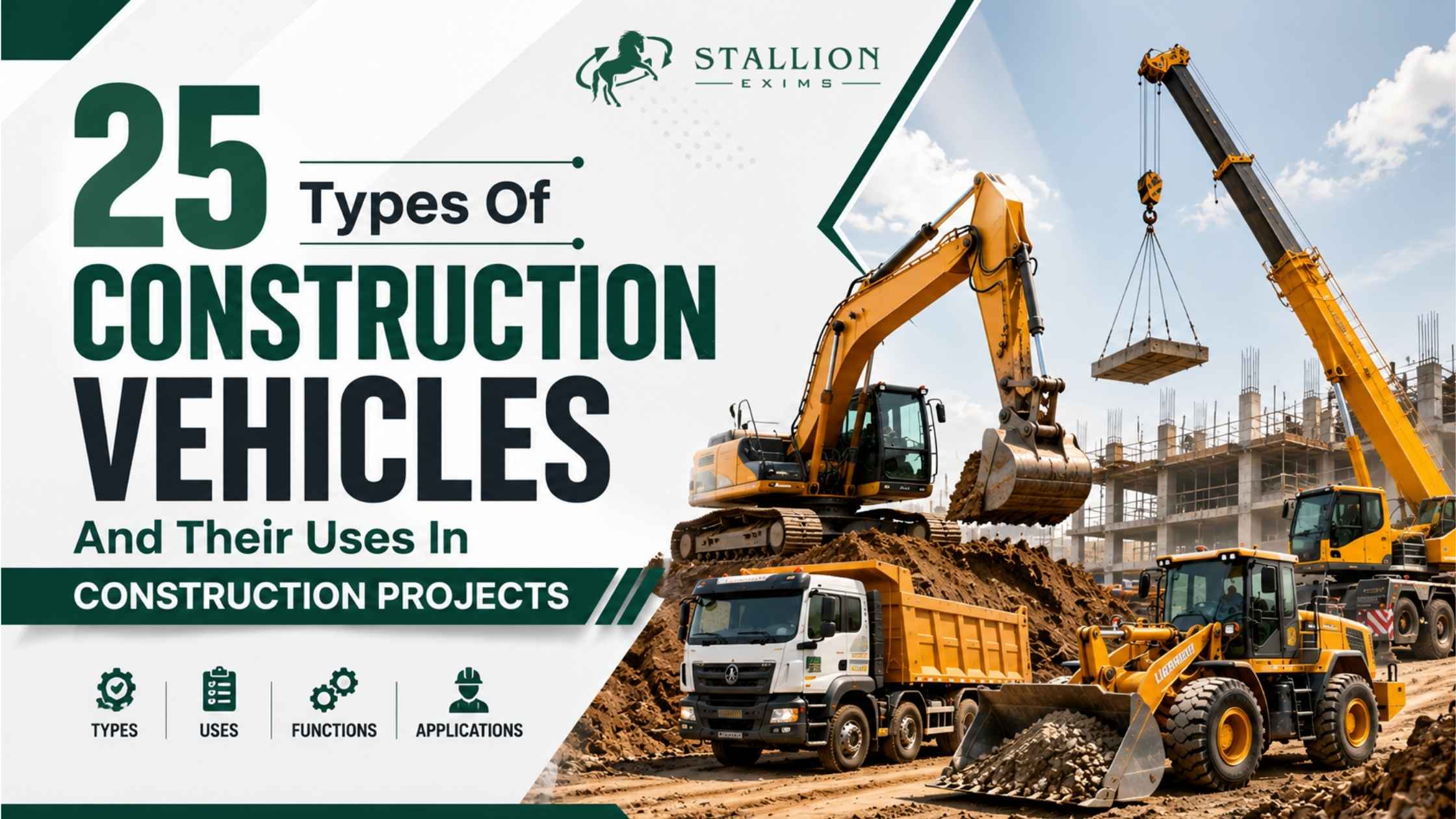
25 Types Of Construction Vehicles And Their Uses In Construction Projects
Published on 24 June 2026•By Prateek Nahar
Construction projects depend on much more than skilled labor. The right types of construction vehicles play a major role in completing work safely, efficiently and on schedule. From excavation and material handling to lifting, hauling and road construction, every machine serves a specific purpose on the job site. Choosing suitable construction equipment helps contractors improve productivity, reduce manual effort and manage projects more effectively. In this guide, we will explore 25 types of construction vehicles and their uses, helping you understand where each machine fits in modern construction projects.
What are construction vehicles?
Construction vehicles are designed to do work that would be too dangerous, too heavy or too slow for manual labor. These machines are used for digging, lifting, compacting and drilling materials, as well as moving them from one job site to another. They are a vital part of the construction equipment and they are used for civil work, road building, industrial projects and building sites. They keep large projects moving forward and are essential to the construction industry.
Different Types of Construction Vehicles Explained
1. Excavators
Excavators are the most common type of earthmoving equipment on any construction site. The excavators use a rotating cab, a bucket and a hydraulic arm to lift debris, dig soil and move material. Contractors use these machines for foundation work such as trenching, demolition and site cleanup.
Uses:
Excavation of foundations
Trenching Tools
Demolition work
Loading materials
2. Backhoe Loaders
Backhoe Loader combine a front loading arm and a rear digging arms in one machine. This makes them very useful for projects that require both digging and loaders without the need to bring in two separate vehicles. These are commonly used on smaller to medium-sized projects, particularly where space is limited.
Wheel loaders have large buckets on the front to quickly move loose materials. Wheel loaders are commonly seen at quarries and road sites, as well as in stockyards where large amounts of material need to be moved quickly. They are useful for working long hours because of their size and power.
Uses:
Moving aggregates
Loading dump trucks
Stockpile handling
Site clearance
4. Mobile Cranes
Mobile cranes can lift heavy loads and place them precisely. Mobile cranes are a great advantage because they can move to new sites and begin work immediately without requiring major installation. These cranes are ideal for lifting large steel beams or other heavy items.
Uses:
Lifting steel sections
Heavy Materials
Equipment placement
Structural installation
5. Tower Cranes
Tower cranes are lifting machines that are used in tall buildings. The cranes are ideal for work in high-rise buildings where materials need to be transported up higher levels. They are used by contractors for long-term lifting.
Uses:
High-rise construction
Lifting to upper floors
Concrete form movement
Steel beam placement
6. Forklifts
Forklifts can be very useful on construction sites, in warehouses and for material handling. Forklifts are used to move palletized products with the forks in front. They also help organize supplies. These are particularly useful when moving materials quickly and over short distances.
Uses:
Pallet loads
Unloading deliveries
Warehouse management
Stacking Supplies
7. Boom Lifts
Boom lifts provide aerial access for workers in hard-to reach areas. The boom lift's extendable arm allows crews to work around obstacles and reach elevated areas with greater freedom than ladders. These are commonly used for maintenance, inspection and installation jobs.
Uses:
Working at Height
Exterior Maintenance
The use of glass and panels
Electric installations
8. Piling Rigs
The piling rigs create deep foundations to support large structures. They use piles to stabilize buildings, bridges and towers. They are most important where the soil is weak and additional support is required below ground level.
Uses:
Deep foundation work
Bridge Support Piles
High-rise basework
Ground reinforcement
9. Boring Rigs
Boring rigs are used to drill holes or underground passages in soil or rock. These rigs are used to construct utility and foundations. These rigs allow crews to complete drilling tasks more efficiently and with less surface damage.
Uses:
Utility Drilling
Foundation holes
Underground Work
Soil analysis
10. Transit Mixers
Transit mixers transport concrete ready-mixed from the batching plants to the construction site. The rotating drum prevents concrete from setting up too soon during transport. These are essential for projects that require fresh concrete to be delivered on time.
Uses:
Concrete transport
Fresh mix delivery
Large pour support
Site concrete supply
11. Concrete Pumps
Concrete pumps are used to move liquid concrete along pipes and hoses. These pumps are helpful when the pouring area is too far away or difficult to reach using normal delivery methods. They are therefore very useful on busy construction sites.
Uses:
High-rise pours
Deep foundation work
Long-distance Placement
Areas that are difficult to reach
12. Crusher Plants
The crusher plants reduce large rocks, construction waste and other materials into smaller pieces. These machines are used for roadwork, recycling and quarrying. Contractors can reduce waste by converting old concrete or stones into aggregate.
Uses:
Crushing rock
Recycling concrete
Producing aggregate
Road base material
13. Batching Plants
The right proportions of cement, water and aggregate are mixed in batching plants to produce high-quality concrete. The plants can be mobile or fixed depending on the project. Concrete mixers are essential for concrete work.
Uses:
Concrete production
Big project supply
Mix control
On-site Batching
14. Tractors
Tractors can be used for towing, pulling and supporting construction sites. They are used in construction to clear land or move materials with the help of trailers and other attachments. Because they are versatile, they can be used on sites with a variety of uses.
Uses:
Towing trailers
Land clearing
Attachments for moving
General support work
15. Skid Steer Loaders
Skid steer loaders can be compact machines, which can turn and work in small spaces. They also have many attachments. These machines are used in residential and commercial construction projects with limited space. They are a good choice for small teams that require a machine to perform multiple tasks.
Uses:
Tight-space work
Grading small areas
Debris removal
Attachment-based tasks
16. Bulldozers
Bulldozers can be used to move soil, shape the ground and clear rough terrain. The heavy equipment used for the early stages of construction includes bulldozers. They can work in rough terrain thanks to their strong track system and blade.
Uses:
Land clearing
Rough Grading
Pushing the soil
Site preparation
17. Dump Trucks
Construction sites use dump trucks the most. They can carry loose materials like dirt, sand and gravel, or demolition waste. The hydraulic bed allows material to be unloaded quickly and efficiently.
Uses:
Hauling soil
Moving aggregates
Remove waste
Material delivery
18. Articulated Haulers
Articulated haulers can handle rough terrain and heavy loads. The jointed frame allows them to move over uneven terrain, mud and slopes where other trucks might struggle. These trucks are used for mining, road construction and earthmoving.
Uses:
Heavy haulage on rough terrain
Mining work
Earthmoving Equipment
Off-road Transport
19. Motor Graders
Motor graders can be used to shape and level surfaces precisely. In road construction, they are essential because they create the correct slope and finish. They are used by contractors when accuracy is important.
Uses:
Fine grading
Road leveling
Drainage shaping
Surface finishing
20. Road Rollers
Road rollers compacte soil, gravel and Asphalt so that surfaces become strong and stable. This machine is essential for roads, parking areas and base layers. Surfaces can crack and sink if they are not properly compacted.
Uses:
Compaction of soil
Asphalt rolling
Work on the base layer
Surface stabilization
21. Asphalt Pavers
Asphalt pavers evenly spread hot asphalt across a prepared surface. The pavers help smooth out roads and driveways, by laying the material at just the right thickness prior to compaction. Modern road construction is impossible without this machine.
Uses:
Paving the road
Parking lot surfacing
Asphalt spreading
Placement of smooth layer
22. Telehandlers
Telehandlers are a combination of lifting reach and material handling flexibility. Like a forklift, they have a boom that allows them to lift and move loads higher. They are great for moving materials to higher levels or over uneven terrain.
Uses:
Lifting Materials
Accessing elevated areas
Pallet handling
Site Material Placement
23. Scissor Lifts
Scissor Lifts allow workers and their tools to access the vertical space directly. These lifts are ideal for people who need a stable work platform to perform indoor tasks or maintenance. They offer more space and better balance than ladders.
Uses:
Ceiling work
Indoor installation
Maintenance work
Vertical access with safety
24. Trenchers
Trenchers can be used to dig long, narrow trenches in order to install pipes, cables and drainage systems. They are faster and cleaner than digging by hand. This makes them an ideal choice for underground utility work and projects.
Uses:
Cable Laying
Pipe trenching
Drainage channels
Utility Installation
25. Cold Planers
Cold planers are used to remove damaged asphalt from roads and prepare them for resurfacing. The top layer of asphalt is ground to a specified depth. This helps improve road quality and recycle the old material. These machines are an important part of road maintenance.
Uses:
Asphalt removal
Resurfacing of roads
Pavement recycling
Surface preparation
How to choose the right construction vehicle for your project?
To maintain productivity and cost-efficiency, it is important to carefully assess the site factors when selecting equipment. The project manager must first evaluate the size of the project and its overall scope. For example, massive earthworks require heavy machinery such as articulated haulers while urban development requires agile skid steers. The terrain conditions will also influence the choice. For example, rubber tires are required for asphalt surfaces and tracked versions for soils that are swampy. Material choice is important because heavy excavators are needed to handle dense rock, while sand can be handled by a loader. Budget targets and equipment availability restrict choices. This requires a balance of upfront rental costs and utility. In the end, evaluating specific job requirements along with site logistics ensures that selected assets are optimized for daily production.
Conclusion
Understanding different types of construction vehicles helps contractors, project managers and equipment buyers choose the right machine for every task. From excavation and material handling to road construction and concrete work, each vehicle plays an important role in improving productivity, safety and project efficiency.
Looking for reliable construction equipment for your next project?Stallion Exims offers a wide range of high-quality construction machinery and equipment designed to meet the needs of contractors, infrastructure projects and industrial applications worldwide.